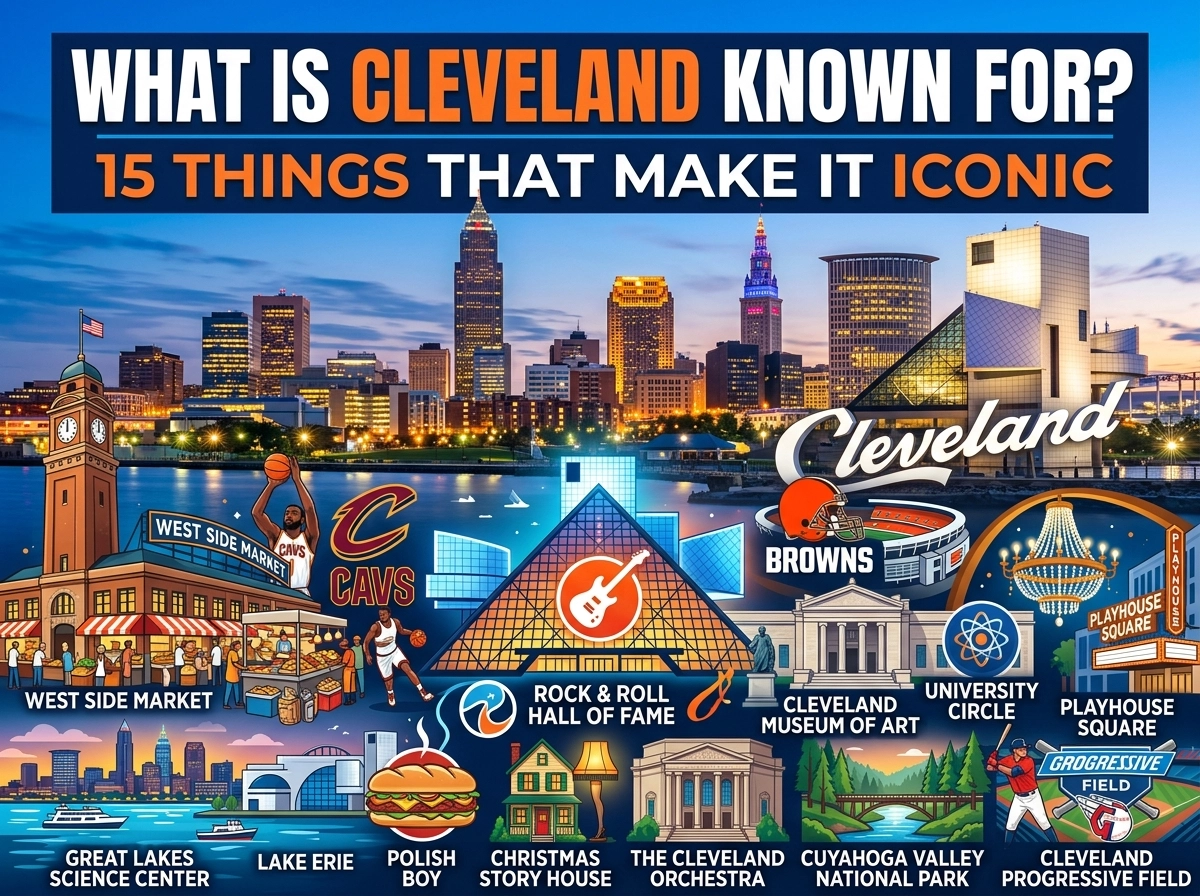
Cleveland is famous for the Rock and Roll Hall of Fame, world-class healthcare at Cleveland Clinic, and a lakefront setting on Lake Erie that shapes everything from the weather to the city's identity. It's also the birthplace of Superman, home to one of the country's best orchestras, and the place where Alan Freed first popularized the term "rock and roll."
This guide covers the 15 things Cleveland is best known for, from iconic landmarks and sports teams to local food, neighborhoods worth exploring, and the industrial history that built the city.
Why Cleveland is called the Forest City
Cleveland is famous for the Rock and Roll Hall of Fame on Lake Erie, world-class cultural institutions like Playhouse Square, and its rich industrial history. The city is also the birthplace of Superman and a major hub for healthcare and performing arts. While Cleveland offers much, you might also be interested in exploring reasons Cincinnati might just be your perfect match if you're considering other Ohio cities.
The "Forest City" nickname goes back to the 1800s, when Cleveland's tree-lined streets stood out among grimy industrial Midwest cities. That green character stuck around. Today, the Cleveland Metroparks form what locals call the "Emerald Necklace," a ring of nature reserves wrapping around the metro area.
Cleveland sits on Lake Erie's southern shore in Northeast Ohio. The lake shapes everything here, from the weather (lake-effect snow is real) to the recreation options to the city's overall feel. If you're trying to understand what makes Cleveland different from Columbus or Cincinnati, or perhaps explore the top restaurants in Cincinnati, start with that waterfront.
15 things Cleveland is famous for
1. Rock and Roll Hall of Fame
The Rock and Roll Hall of Fame is the first thing most people picture when they think of Cleveland. The museum sits in a glass pyramid designed by architect I.M. Pei, right on the Lake Erie waterfront downtown.
Why Cleveland and not Memphis or New York? DJ Alan Freed popularized the term "rock and roll" while working at a Cleveland radio station in the early 1950s. The museum houses artifacts from music legends, and the annual induction ceremonies draw fans from around the world.
2. Playhouse Square theater district
Playhouse Square is the largest performing arts center in the United States outside New York City. Five restored 1920s theaters cluster together in downtown Cleveland, hosting Broadway tours, concerts, ballet, and opera.
The outdoor chandelier hanging above Euclid Avenue is the world's largest. At night, it lights up the entire theater district. Even if you're not catching a show, walking through Playhouse Square after dark is worth the detour.
3. Cleveland Clinic and the city's healthcare industry
Cleveland Clinic consistently ranks among the top hospitals in the world, particularly for cardiology and heart surgery. Healthcare is one of the largest employment sectors in the region, and University Hospitals is another major system based here.
Together, the two institutions make Cleveland a destination for patients seeking specialized care. They're also steady employers, which matters for the local economy.
4. Cleveland Orchestra at Severance Music Center
The Cleveland Orchestra regularly ranks among the top five orchestras globally. Founded in 1918, the orchestra performs at Severance Music Center (formerly Severance Hall), an architectural landmark in the University Circle neighborhood.
Even if classical music isn't your thing, attending a performance at Severance is worth it for the building alone. The orchestra is known for its recordings and international tours, but the home venue is where you get the full experience.
5. Cleveland Museum of Art
The Cleveland Museum of Art offers free general admission to a permanent collection spanning 6,000 years of art history. The museum sits in University Circle alongside other cultural institutions.
Free admission means you can drop in for an hour without committing to a full-day visit. The collection is world-class, and the building itself went through a major expansion in 2012 that added modern gallery space.
6. West Side Market
West Side Market has operated since 1912 in the Ohio City neighborhood. The yellow brick building with its clock tower is a Cleveland landmark, and more than 100 vendors sell produce, meats, baked goods, and ethnic foods inside.
This is where you'll find pierogis, fresh kielbasa, and Middle Eastern pastries under one roof. Saturday mornings get crowded, so arriving early makes browsing easier.
7. Lake Erie waterfront and Edgewater Park
Cleveland's position on Lake Erie gives the city beach access, waterfront parks, and dramatic sunsets over the water. Edgewater Park is the most popular spot, with a beach, picnic areas, and skyline views.
The lakefront also shapes Cleveland's weather. Lake-effect snow hits hard in winter, while summer brings cooler breezes than you'd find inland. The lake is part of daily life here, not just a tourist attraction.
8. Cleveland Metroparks and Cuyahoga Valley National Park
The Cleveland Metroparks system includes 18 reservations forming the "Emerald Necklace" around the city. Hiking, biking, and nature programs run year-round.
Just south of Cleveland, Cuyahoga Valley National Park is one of the most visited national parks in the country. Brandywine Falls is the most photographed spot, and the Cuyahoga Valley Scenic Railroad runs through the park for a slower way to see the scenery.
9. The birthplace of Superman
Jerry Siegel and Joe Shuster, two students at Glenville High School, created Superman in the 1930s. The Glenville neighborhood on Cleveland's east side has Superman-related landmarks, including a marker at Siegel's former home.
Most visitors don't expect this piece of pop culture history. Cleveland doesn't advertise it heavily, but comic book fans make the pilgrimage.
10. Cleveland Browns and the Dawg Pound
The Cleveland Browns are one of the NFL's most storied franchises, with a passionate fanbase that fills Cleveland Browns Stadium on the lakefront every fall. The "Dawg Pound" section behind the east end zone is famous for its intensity.
The team hasn't won a championship since 1964, yet Browns fans remain fiercely loyal. Game days transform the downtown area.
11. Cleveland Guardians at Progressive Field
The Cleveland Guardians (formerly the Indians, renamed in 2022) play at Progressive Field downtown. The ballpark consistently ranks among the best in Major League Baseball for sightlines and atmosphere.
Progressive Field is walkable from hotels, restaurants, and other downtown attractions. Summer evening games with the skyline in view are a Cleveland experience worth having.
12. Cleveland Cavaliers and the 2016 NBA championship
The Cleveland Cavaliers ended a 52-year major sports championship drought in 2016, beating the Golden State Warriors in the NBA Finals. LeBron James, who grew up in nearby Akron, led that team.
The Cavaliers play at Rocket Mortgage FieldHouse downtown. That 2016 championship remains a defining moment for the city.
13. Polish Boy sandwich and Cleveland food culture
The Polish Boy is a Cleveland original: a kielbasa sausage topped with french fries, coleslaw, and barbecue sauce, all stuffed into a bun. It reflects the city's Eastern European immigrant heritage.
Other local staples include Slyman's Deli corned beef sandwiches (piled absurdly high) and pierogis served at neighborhood restaurants. Cleveland's food identity leans toward hearty, unpretentious, and influenced by immigrant communities.
14. Great Lakes Brewing Company and craft beer
Great Lakes Brewing Company opened in Ohio City in 1988, making it a pioneer of the Midwest craft beer movement. Their Christmas Ale is a regional obsession every winter.
Cleveland's brewery scene has grown since then, with concentrations in Ohio City, Tremont, and downtown. Breweries here tend to be neighborhood gathering spots rather than industrial taprooms.
15. Cleveland's industrial history and inventions
Cleveland was a major industrial center in the early 20th century. John D. Rockefeller founded Standard Oil here, and the city led in steel, oil refining, and manufacturing.
The first electric traffic signal was installed at East 105th Street and Euclid Avenue in 1914. That industrial legacy shaped Cleveland's architecture, neighborhoods, and the "Rust Belt" identity the city has spent decades redefining.
Cleveland neighborhoods worth exploring
Cleveland's neighborhoods have distinct personalities. Knowing where to go depends on what you're looking for.
Ohio City
Ohio City surrounds West Side Market and extends along West 25th Street. Breweries, restaurants, and coffee shops line the main strip. The residential streets have restored Victorian homes and a walkable feel.
Tremont
Tremont sits south of downtown with a trendy dining scene, art galleries, and Lincoln Park at its center. Young professionals and artists have moved here over the past two decades, and the restaurant density rivals Ohio City.
Little Italy
Little Italy is a historic Italian-American neighborhood near University Circle. Restaurants, bakeries, and art galleries cluster along Mayfield Road. It's walkable from the art museum and other University Circle attractions.
University Circle
University Circle packs the art museum, natural history museum, botanical garden, and Severance Music Center into one square mile. It's one of the densest concentrations of cultural institutions in the country.
Downtown and the Warehouse District
East 4th Street downtown has become a dining and entertainment hub. The Warehouse District nearby is known for loft apartments and nightlife. All three major sports venues are within walking distance.
What food is Cleveland known for
Cleveland's food scene reflects its immigrant history and Midwest sensibility. Here's where to find the local staples:
|
Cleveland food |
What it is |
Where to try it |
|
Polish Boy |
Kielbasa with fries, slaw, BBQ sauce |
Seti's, Hot Sauce Williams |
|
Corned beef sandwich |
Piled-high deli classic |
Slyman's Deli |
|
Pierogi |
Stuffed dumplings |
Sokolowski's University Inn |
|
Craft beer |
Local brews |
Great Lakes Brewing, Market Garden |
Cleveland sports teams and where they play
All three major professional teams play in or near downtown Cleveland, making it easy to catch a game regardless of the season.
|
Team |
Sport |
Venue |
Location |
|
Cleveland Browns |
NFL |
Cleveland Browns Stadium |
Lakefront |
|
Cleveland Guardians |
MLB |
Progressive Field |
Downtown |
|
Cleveland Cavaliers |
NBA |
Rocket Mortgage FieldHouse |
Downtown |
The venues are walkable from each other, and game days bring energy to the surrounding bars and restaurants.
Famous people from Cleveland
Cleveland has produced notable figures across sports, entertainment, and business:
-
LeBron James: NBA legend, born in Akron but career defined by Cleveland
-
Jesse Owens: Olympic track star who grew up in Cleveland
-
Halle Berry: Academy Award-winning actress
-
Drew Carey: Comedian and TV host known for his Cleveland pride
-
Bone Thugs-n-Harmony: Hip-hop group from Cleveland's east side
-
Alan Freed: DJ who popularized the term "rock and roll"
Inventions and firsts that started in Cleveland
Cleveland's industrial era produced several firsts:
-
First electric traffic signal: Installed at East 105th and Euclid in 1914
-
Standard Oil Company: John D. Rockefeller founded it here
-
Life Savers candy: Invented in Cleveland
-
Superman: Created by two Cleveland teenagers in the 1930s
Is Cleveland safe to visit
Cleveland's crime statistics appear in national rankings, which can concern first-time visitors. The tourist areas, including downtown, University Circle, Ohio City, and Tremont, are generally safe with standard urban precautions.
Like any mid-sized American city, some neighborhoods have higher crime rates than others. Sticking to the areas covered in this guide, especially during daytime and evening hours, is a reasonable approach.
How to find trusted local businesses in Cleveland
Cleveland's neighborhood-based economy means local businesses are central to the experience. Whether you're looking for a restaurant recommendation in Tremont or a service provider in Ohio City, verified reviews help you avoid wasted time and money.
Local directories with audited business profiles and real customer reviews make it easier to find trustworthy options. Localeadr helps visitors and residents discover verified local businesses across categories like restaurants, services, and retail.
Frequently asked questions about Cleveland
What is the best time of year to visit Cleveland?
Late spring through early fall offers the best weather for outdoor activities and lakefront access. May through October brings festivals, outdoor concerts, and baseball season.
What does "The Land" mean as a Cleveland nickname?
"The Land" is a shortened form of Cleveland used as a term of local pride. It became popular through sports culture and appears on merchandise and in local speech.
Is Cleveland or Columbus bigger?
Columbus has a larger city population and is Ohio's capital. Cleveland has a larger metropolitan area population and is historically the state's economic center. For those considering other Ohio cities, understanding the pros and cons of living in Cincinnati can offer a broader perspective.
What airport do you fly into for Cleveland?
Cleveland Hopkins International Airport (CLE) is the main airport, located about 15 minutes southwest of downtown with direct flights to most major U.S. cities.
Why is Cleveland called a Rust Belt city?
Cleveland was a major manufacturing and steel center through the mid-20th century. "Rust Belt" refers to Midwest cities that experienced industrial decline, though Cleveland has since diversified into healthcare, technology, and cultural industries.